Madagascar's Ranalahy: A Botanical Wonder to Discover
Mar 19, 2026 - 6 min reading
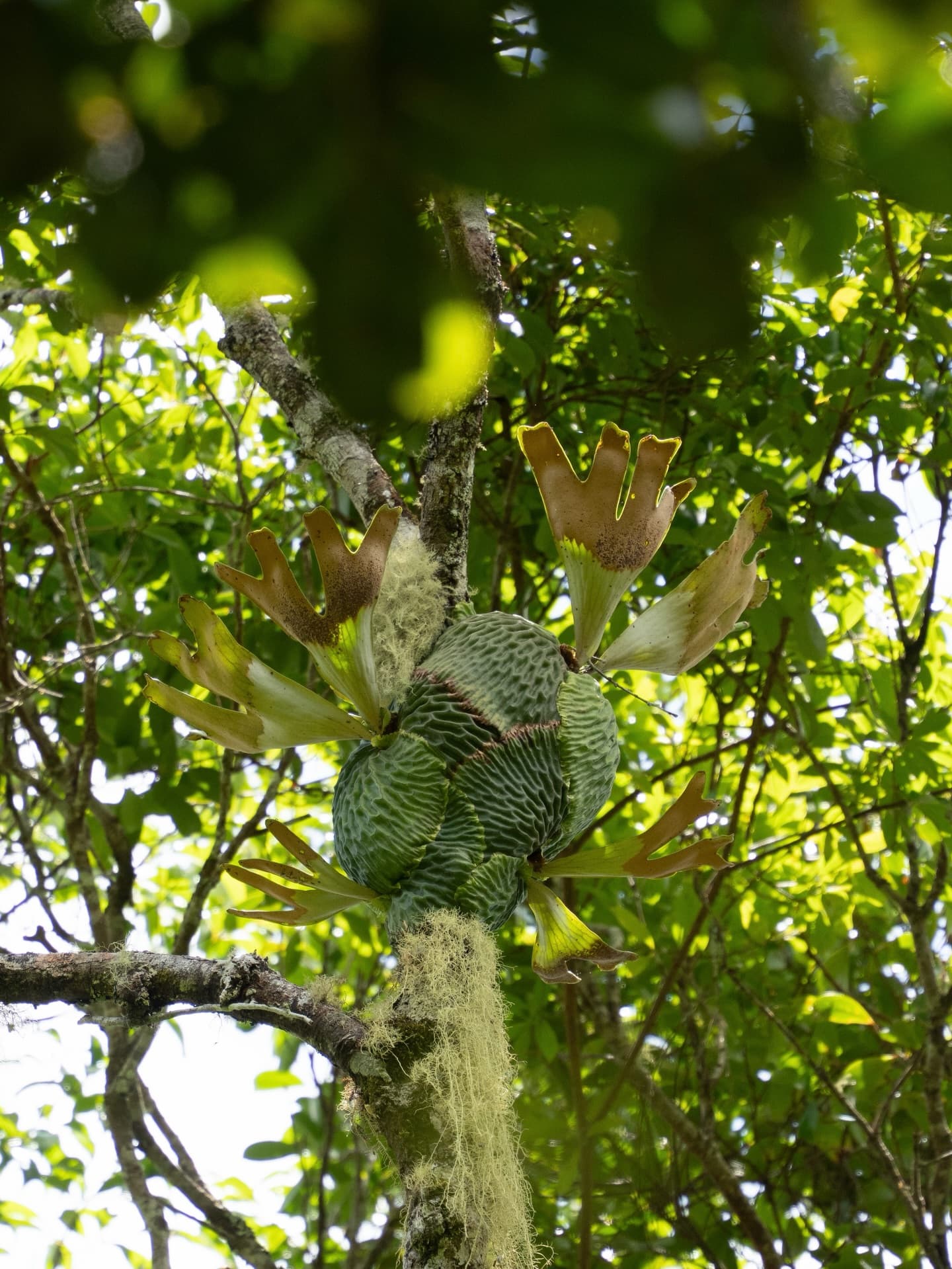
Platyceriums (the name comes from the Greek 'platus' flat and 'keras' horn), also known as staghorn or elkhorn ferns, are epiphytic ferns from the Polypodiaceae family found in warm regions. French botanist Nicaise Augustin DESVAUX first described them in 1827. The genus comprises around 18 species worldwide. 6 are found in Africa, with 4 originating from Madagascar! Locals call them 'ranalahy' (male zebu).
RANA: THE PLANT THAT MOOS
Considered a bad omen by Malagasy people, the staghorn fern is said to moo like a zebu to announce a death or misfortune. Generally, few people dare to share information about this.
In reality, this sound comes from the rustling of the leaves caused by the wind.
MALE AND FEMALE PLANTS
Malagasy people distinguish 2 groups of Platyceriums based on the appearance of the basal frond (shield or sterile frond): female is used to indicate Platycerium madagascariense, whose sterile frond has a honeycomb-like shape, and male for the other 3 species, Platycerium alcicorne, Platycerium ellisii, and Platycerium quadridichotomum, which have more or less smooth sterile fronds.
4 SPECIES OF PLATYCERIUM IN MADAGASCAR
Platyceriums in Madagascar are difficult to access and are now rare in the wild. The shrinking of forests and excessive collection make it challenging to observe them in their natural habitats.
1st~PLATYCERIUM ALCICORNE
Found mainly in the eastern forest complex of Madagascar. We were able to observe and photograph a few specimens in a very small forest fringe, hours of walking from the town of Andaingo. Unfortunately, they are facing imminent extinction due to the severe degradation of their habitat caused by gold prospectors.
2nd~PLATYCERIUM ELLISII
We found this species in the coastal forest along the banks of the Pangalanes Canal. Its habitat is diminishing due to bushfires, charcoal production, and wood collection.
3rd~PLATYCERIUM QUADRIDICHOTOMUM
This species from dry regions can be observed in the deciduous forests of Bemaraha and Ankarana.
4th~PLATYCERIUM MADAGASCARIENSE
A species from the eastern rainforest, it is present but very rare in Analamazaotra, Iakora, and Maromizaha.
These 4 species of Platycerium are part of Madagascar's natural and floral richness.
Unfortunately, we Malagasy people are unaware of them and do not realize their significant biological, cultural, ecological, and economic value and importance. They are tending to disappear forever along with the forests, their natural habitat. Urgent actions and large-scale awareness campaigns are needed to save them from extermination in the wild.
This publication invites you to discover and better understand our rich heritage.